
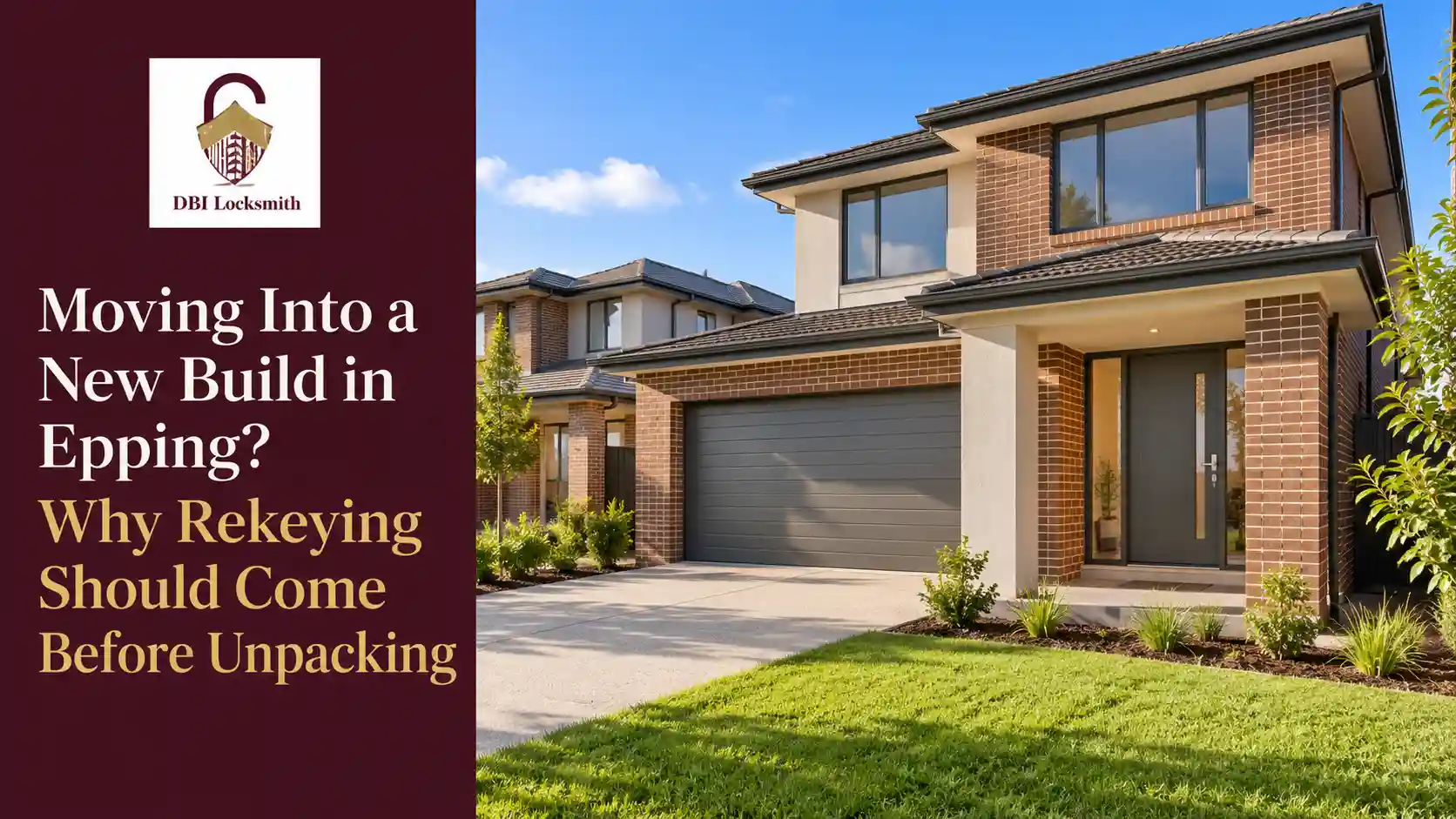
Epping’s northern growth corridor is one of Melbourne’s most active new-estate zones. The Aurora Estate on Harvest Home Road, Hargrove Estate, the former Harvest Views and Hayston Views releases — and the massive New Epping development coming online soon on the former quarry site — all tell the same story: thousands of families moving into brand-new homes across this suburb every year. First home buyers, young families, people who’ve saved hard for a house-and-land package, people who’ve upsized from a unit or relocated from an older suburb.
Moving into a new build is a particular experience. Everything is fresh — new carpets, crisp painted walls, untouched kitchen benches, a garage that still smells of fresh concrete. It’s a significant milestone and, understandably, the last thing most new Epping homeowners are thinking about at that moment is the locks.
But the locks are exactly where a new home’s security starts, and a new build in Epping creates a specific set of circumstances that make rekeying on move-in day not just sensible — it’s the most important security decision you’ll make in that first week.
Who Had Keys to Your New Home Before You Did
The common assumption about a new build is that you’re the first occupant, so the security situation is clean. In terms of who’s lived there, yes. In terms of who’s had keys — it’s a different picture entirely.
A new estate home in Epping goes through a construction timeline that typically spans six to twelve months from slab to handover. Across that period, the property is accessed regularly by trades: concreters, framers, plumbers, electricians, plasterers, tilers, painters, landscapers, carpenters fitting cabinetry, inspectors from the building surveyor, and from the builder’s site manager. Most builders use a construction master key during the build phase — a single key that operates every lock on every home being built across the estate at that time. This key is held by the site manager, distributed to subcontractors as needed, and used by anyone who needs access during the build.
At practical completion and handover, the builder hands over two or three keys cut to the specific lock configuration of your home, and the construction master is supposed to be retired from that point. But the construction master that worked your door still works it — there is no mechanism that deactivates it at handover. Anyone who held or copied that master during the build period retains access.
Beyond the construction master: individual trade keys are sometimes cut for tradespeople working independently on a site. The property may have been accessed by a building inspector before final inspection. The display home for the estate release may have shared a key pattern with your property during the show home phase. None of this is documented in what you receive at handover.
A rekey on move-in day closes all of this. The existing cylinders are repinned so that every prior key — the construction master, any individual trade copies — no longer works. The only operative keys are the new ones cut at the time of rekeying. The key history of the build period is completely reset.
Pro Tip: Book the rekey as a fixed appointment for move-in day or the day before — not “sometime in the first week.” A first week in a new home fills up immediately, and the key security of a property you’ve worked years to buy deserves a scheduled time, not a deferred intention.
The Builder’s Standard Lock: What You’re Starting With
New estate homes in Epping — across Aurora, Hargrove, and the current releases — are typically delivered with builder-standard lock hardware. Builder-standard locks are sourced from a hardware wholesaler that supplies the building company at volume, and they sit at a price and specification level that suits a builder’s budget rather than a homeowner’s security requirements.
In Australian terms, the appropriate specification for an external residential deadlock is Grade 5 or Grade 6 under the AS 4145 standard. Builder-standard locks in new estate homes typically rate at Grade 3 or Grade 4. They function — the bolt extends, the door closes and locks — but they’re not rated to the resistance standards a Grade 5 or 6 provides against picking, drilling, and physical forcing.
The cylinder within the builder-standard lock is also typically a non-restricted keyway. Any hardware store key kiosk — at Pacific Epping or Costco on Cooper Street — can cut a copy of a non-restricted key. A restricted-keyway cylinder, managed through a licensed locksmith, means that copies can only be cut by the registered system holder with written authorisation. Upgrading to a restricted keyway cylinder at the same time as the move-in rekey costs a modest additional amount and provides key control for the life of the hardware.
On a 4-bedroom, 2-bathroom double-storey Epping estate home worth $775,000 to $854,000 at current median prices, the security hardware on the external doors should reflect that value. Upgrading from builder-grade to Grade 5 or 6 hardware is not a luxury — it’s the appropriate specification.
New Estate Homes and the Sliding Door
New Epping estate homes — particularly the 4-bed double-storey designs that dominate the Aurora and Hargrove releases — almost universally include a large sliding glass door from the family living area to the outdoor entertaining area or backyard. This door is a standard feature of the estate home design and the source of one of the most consistent security gaps in new build properties.
Builder-standard sliding doors are fitted with a face-lever latch: a handle mechanism on each face of the panel that holds the door closed. This is not a security lock. It is a closure mechanism. A face-lever latch on a standard sliding door can typically be defeated by inserting a thin tool between the door panels and disengaging the latch, or by lifting the panel from the track if no anti-lift device has been fitted.
Two upgrades address this. An anti-lift pin or block in the top channel prevents the panel from being lifted free of the track. A secondary lock — either a key-operated track bolt or a security blocking bar — provides resistance to horizontal forcing. Both can be fitted to a builder-standard sliding door in under an hour and transform the security status of that opening from “closure latch” to “secured entry point.”
Pro Tip: On a new Epping estate home, the sliding door to the alfresco area is typically the least-secured external opening on the property — more so than the front or garage entries that receive more visible attention. Address it in the same visit as the move-in rekey.
What the Move-In Security Visit Covers
A move-in security visit on a new Epping estate home is straightforward but comprehensive. The locksmith assesses every external entry point — front door, rear door, sliding door, garage internal door, any side entry — and provides a clear picture of the security status of each.
Front entry deadlock: cylinder grade, key control, strike plate configuration (whether it’s correctly anchored into the structural jamb rather than just the door lining), and whether the builder has fitted an appropriate security screen or storm door.
Rear and alfresco entries: the sliding door assessment above, any secondary rear entry doors, laundry entries.
Internal garage door: on estate homes with an attached double garage, the door from the garage to the interior of the home is a critical but often overlooked security point. If this door has a passage set rather than a deadlock, anyone who accesses the garage — by the roller door, which has its own vulnerabilities — has effectively bypassed the home’s external security.
At the end of the visit, every external entry point on the property is rekeyed to a single new key, a restricted-keyway cylinder is fitted where appropriate, and the homeowner has a clear understanding of what’s been done and what, if anything, requires further attention.
A Harvest Home Road Move-In: How It Went
I was called to a new build in the Aurora estate area, Harvest Home Road — a young family who’d settled on their first home six months after construction. They’d been renting in Mill Park while the build finished and were understandably excited to finally move in. The keys they received at handover were two copies of a standard non-restricted key.
Front door: builder-standard Grade 3 deadlock, no security screen fitted. Rear sliding door: face-lever latch, no anti-lift, no secondary lock. Internal garage door: hollow-core panel door with a passage set — no deadlock. Strike plate on the front entry: face-mounted with short screws into the door lining.
We rekeyed the front and rear entries to a restricted-keyway cylinder, fitted an anti-lift pin and track lock on the sliding door, fitted a proper deadlock on the internal garage door, and replaced the front entry strike plate with a full-box strike on 75mm screws. New keys: three copies to the homeowners, signed for at issue.
Total time: Two hours. The family moved their furniture in that afternoon knowing exactly who had access to their new home: just them.