
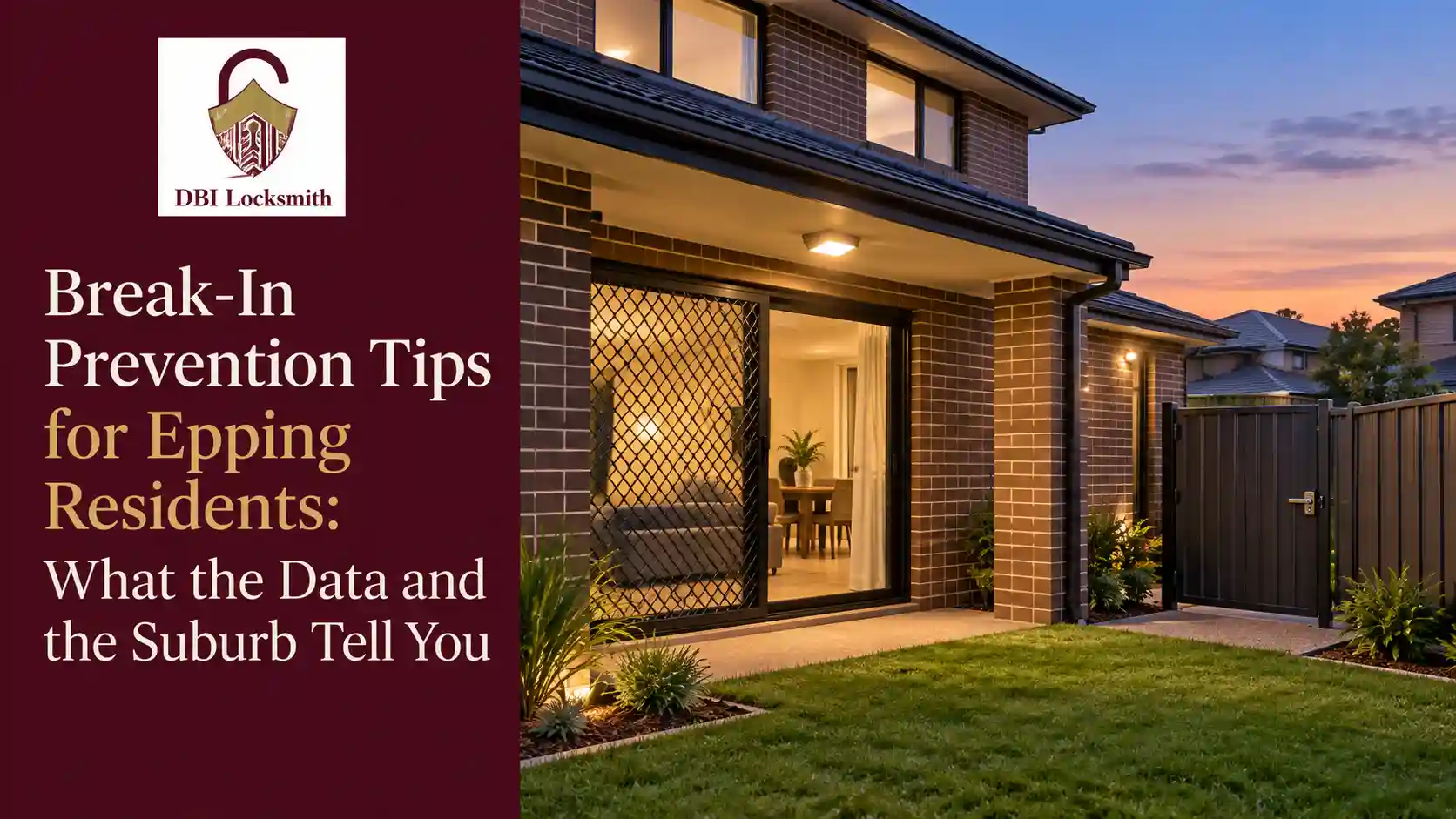
Epping’s crime profile has worsened over the past five years. Total offences are up 22%, theft up 6.95%, and property and deception offences account for the largest single category of crime in the suburb — 2,970 incidents per year. The one positive trend in the most recent data: residential burglary is down 19.29% year-on-year in 2026, suggesting that the security investments many Epping residents have made are working.
The probability context: Epping residents currently face a 1 in 15 chance of being a property crime victim in any given year. That doesn’t mean it’s likely for any individual household — but it means property crime is a genuine, active risk in the suburb, not a theoretical concern.
Epping’s character makes this risk profile understandable. A suburb of dual-income families with 1.9 vehicles per household and long daily working absences. A rapidly growing population creating new estates where security awareness varies widely among new movers. An older established core where homes have gone years without security attention. And a crime rate that’s above the Victorian average. The conditions for opportunistic property crime are present.
The following is a practical, suburb-specific guide to what actually reduces that risk for Epping homeowners — not a generic security checklist, but an honest view of where Epping’s specific exposure sits.
How Opportunistic Burglary Works in an Outer-Growth Suburb
Epping’s character is different from an inner-Melbourne suburb when it comes to property crime. In an inner suburb, density provides natural surveillance: neighbours are close, foot traffic on residential streets is consistent, activity is visible. In an outer-growth suburb like Epping, the dynamics are different. Newer estate streets — particularly in the Aurora area and the Harvest Home Road corridor — have wider blocks, longer driveways, double garages that obscure the front entry from the street, and rear gardens that back onto other rear gardens rather than laneways or public paths.
An opportunistic intruder in this environment is reading a small number of signals: Is the property clearly empty (no cars in the driveway, no visible activity)? Is there an easy, low-visibility approach to a low-resistance entry point at the rear? How long before anyone from the street would see activity at this property?
In Epping’s established central streets around High Street, the assessment is different — older homes, less uniform blocks, more variable surveillance. The common thread: the rear of the property is the approach path of choice, and the rear entry is typically where security attention has been least applied.
The Specific Vulnerabilities on Epping’s Two Housing Types
New estate homes (Aurora, Hargrove, current and recent releases):
The builder-standard sliding door from the family area to the alfresco is the most consistent vulnerability. Face-lever latch only, no anti-lift, no secondary lock — as discussed in detail elsewhere, but worth noting here as the single most common weakness on Epping’s new estate properties.
The internal garage door is the second. A double garage is standard on Epping estate homes; where the garage is attached and the internal door to the house is a hollow-core panel door with a passage set, access through the garage — via a fixed-code roller door, via leaving the garage door open during the working day, or via the pedestrian door to the garage if one is fitted with a weak lock — gives access to the house.
Established central Epping brick homes:
Older deadlocks that have never been upgraded. On homes purchased or rented in Epping’s original village area, the lock hardware may date from the 1970s or 1980s, operating at Grade 2 or 3, with cylinders that have been copied multiple times across multiple owners.
Louvre doors on rear entries: common on 1970s Melbourne construction. Louvre panels can be removed or broken without touching the door frame, making a louvre-fitted rear door effectively unprotected regardless of what lock is on the door.
Original sash windows or aluminium sliders with friction latches: latched but not locked.
Pro Tip: Identify the weakest entry point on your Epping property and address it first — not the front door, which is likely already the best-secured entry. The rear sliding door or the laundry door is usually where the gap is, and it’s where an opportunistic approach will probe first.
The Layered Approach: How Each Security Measure Works Together
No single security measure eliminates residential burglary risk. What reduces it is a sequence of overlapping measures that collectively make the property a poor choice for opportunistic entry.
Layer one — access control: deadlocks at Grade 5 or above on every external entry. Secondary lock and anti-lift on the sliding door. Key-operated locks on accessible ground-floor windows. Deadlock on the internal garage door. Gate lock on any side passage providing unobserved access to the rear. This layer makes every entry point resistant to quick, low-skill bypass.
Layer two — deterrence: motion sensor lighting on rear and side approaches. A property where movement at night activates high-intensity lighting is less comfortable for an approach than an unlit one. A P2-rated security screen on the front entry provides a visual deterrent and physical resistance simultaneously. CCTV aimed at the approach paths changes the risk calculation — even a camera that’s visible without being operational provides deterrence for opportunistic entry.
Layer three — detection: a monitored alarm with a response rather than a local bell. The bell alone makes noise; monitored means someone responds. For Epping households with long working absences — dual-income families away from 7am to 6pm — an unmonitored alarm that sounds for twenty minutes in an outer suburb with detached housing and long block lengths is a different deterrent from one that triggers a monitoring centre response.
Pro Tip: Sensor lighting at the rear of an Epping property — aimed at the approach from the back fence or side yard — costs under $150 in hardware, takes thirty minutes to fit, and provides deterrent value around the clock with no ongoing cost. It’s the highest-value break-in prevention investment available per dollar for most Epping homes.
The Garage: Epping’s Most Underestimated Security Risk
Epping’s two-car estate homes have double garages as a standard design feature. This creates a specific security consideration that single-garage or no-garage properties don’t face: the garage is a large, mechanically operated entry point that receives less security scrutiny than the front door.
Roller door vulnerabilities on older systems: fixed-code remote openers — common on garage systems installed before approximately 2005 — use a fixed radio code that can be duplicated by a cheap code-scanning device. Rolling-code technology, standard on all current garage remote systems, eliminates this vulnerability. If the garage system on an Epping home pre-dates rolling-code technology, an upgrade is straightforward and inexpensive.
The pedestrian door beside the garage roller: many Epping estate homes have a pedestrian access door in the garage wall, separate from the roller. This door frequently has a passage set rather than a deadlock. A passage set on the garage pedestrian door means someone who can reach that door — from the side of the property, through a side gate — has a path to the interior of the garage.
The internal garage-to-house door: as above — this is the critical junction. If the garage can be accessed and the internal door doesn’t have a proper deadlock, the garage essentially functions as a vestibule to the house interior.
What the Absence Windows Look Like in Epping
Epping families leave early. School drop-off is before 9am; the Northern Hospital shift handover is at 7am and 3pm; the Mernda line services to the CBD run from 5:30am. By 9am on a weekday, a significant proportion of Epping’s family homes are empty — both vehicles in the driveway can belong to a home that has no one in it (one car stayed at the station, one partner took the other vehicle).
The absence window runs through to school pickup at 3-3:30pm — or to 6pm or later on full-day working household schedules. A six to nine-hour daily absence window, consistent across the working week, is the condition that opportunistic property crime in outer-suburban Epping exploits.
The security response to this pattern isn’t complicated — it’s the layered approach above, applied specifically to the rear and side access points that are the first ports of call for an approach made during a daily absence window. A front door that looks lived-in (good visible hardware, security screen) and a rear that’s actually secured (sliding door locked, sensor light, side gate bolted) shifts the property into the “too difficult” category that opportunistic entry avoids.
A Cooper Street Area Assessment: The Full Picture
I was called to a four-bedroom brick home in the established streets east of Cooper Street — a family who’d lived there for six years and had been prompted by a break-in two streets over. They’d never had a formal security assessment.
Front entry: Grade 4 deadlock, reasonable condition, no security screen. Rear: a louvre door off the laundry — the louvres were original 1970s glass, six panels, in a timber frame. Side access gate to the rear garden: a standard latch bolt. Double garage: attached, internal door to the kitchen via a hollow-core panel door with a passage set. Two ground-floor windows on the rear: aluminium sliders with friction latches. No sensor lighting anywhere at the rear.
We replaced the laundry louvre door with a security grille door, fitted a deadlock on the internal garage door, installed key-operated locks on the two rear windows, fitted a lockable gate bolt on the side access, and fitted two sensor lights covering the rear approach from the back fence and the side gate area. The front deadlock was upgraded to Grade 5 with a restricted keyway; a P2 security mesh screen door was fitted.
The assessment revealed a property where all the security attention had been on the front door — correctly — while the rear had been left in essentially its original 1970s state. The louvre door alone would have been the entry point of choice.