
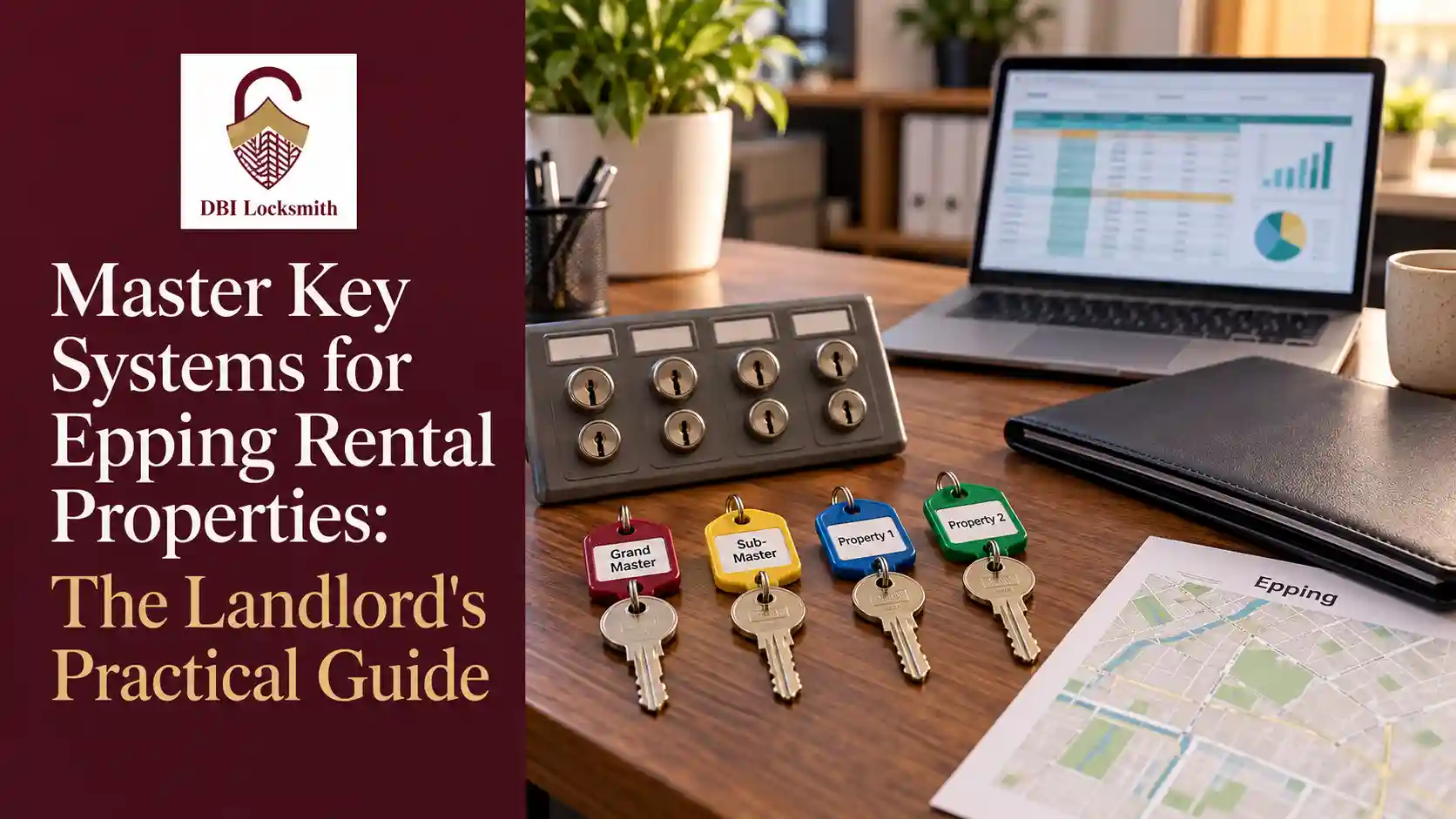
Epping’s rental market is active and growing. With 29.4% of households renting, a vacancy rate of just 1.49%, and a suburb expected to grow from 33,000 residents to 50,000 by 2030, Epping has attracted consistent investment buying since the Aurora Estate began absorbing demand in the 2000s. Many Epping property investors own two or more dwellings in the suburb — a mix of estate houses, established brick homes, and the growing townhouse stock on the new development sites off Edgars Road and Epping Road.
Managing physical keys across a rental portfolio is one of the most time-consuming and security-vulnerable elements of property management. It’s typically handled reactively: a new tenancy means cutting new keys, a departure means a key return conversation, a dispute means a lock change decision, a property manager coordination request means a physical key handover. Each of these is a discrete event requiring attention and often a trip to or from the property.
A master key system replaces reactive key management with a designed, documented, controlled access hierarchy. It doesn’t eliminate the administrative work of tenancy management — but it reduces the security exposure and the operational friction substantially.
The Key Management Gap in a Typical Epping Rental Portfolio
Consider a standard two-property Epping investment scenario over three years. Two houses — perhaps one in the Aurora area, one in the established central Epping streets. Each cycles through one to two tenancies per year. Each tenancy involves issuing two to four keys; some tenants request additional copies; some keys are not returned at lease end. The property manager holds a set for inspection and emergency access. Over three years: potentially fifteen to twenty keys in circulation, with a history that’s hard to fully reconstruct.
The standard operating approach: change the locks when a tenancy ends badly, or when a key is reported lost. Accept the uncertainty otherwise — it’s a risk most landlords assess as manageable. But “manageable” risk is different from “controlled” risk. A past tenant who retained a key copy has a key that works until the lock is changed. And if the key is on a standard non-restricted keyway, it could have been copied before it was returned.
A master key system with a restricted keyway changes this from a managed risk into a controlled one: every key in the system is documented, copies can only be made through the registered locksmith with written authorisation, and the response to a tenancy ending is a controlled rekey of that specific property within the system — not a decision about whether to change the locks.
Pro Tip: Set up your Epping master key system with the first property and register it correctly from day one — adding a second or third property to an established system is straightforward; retrofitting documentation and key control to a system that’s been running informally for three years is much harder.
How a Master Key System Works
Cross-keying is the mechanism: each lock cylinder is pinned to respond to its individual key (which opens only that cylinder) and to a master key (which opens all cylinders in the system). This is achieved through a specific pin stack configuration inside the cylinder. It doesn’t reduce the cylinder’s security against unauthorised entry — both the individual key and the master key operate correctly, but no other key does.
For an Epping rental portfolio, the three-level hierarchy:
Tenant keys: Open only the cylinders for the specific property that tenant occupies. A tenant in the Aurora estate property cannot use their key on the Edgars Road property, and vice versa. Each tenant’s keys are specific to their tenancy.
Property manager sub-master: Opens all properties in the portfolio. One key, all inspections, all emergency access situations, all maintenance coordination. The property manager doesn’t need to track which key belongs to which property — the sub-master handles all of them.
Landlord grand master: Also opens all properties. Typically two copies, held by the landlord, stored separately. Backup to the property manager access.
The restricted keyway: All cylinders in the system use a keyway managed by the system locksmith — a profile that requires a key blank not available at any hardware store or key kiosk. Tenants cannot copy their keys at Pacific Epping’s key kiosk or at the Costco on Cooper Street. Copies can only be made by the registered system locksmith, against the key register.
What Rekeying Within the System Looks Like
When a tenancy ends — either naturally or on difficult terms — rekeying within a master key system is a contained, specific response. The locksmith visits the affected property and repins the cylinder (or cylinders) for that property so the former tenant’s individual key no longer works. The property manager sub-master continues to work. The landlord grand master continues to work. No other property in the portfolio requires any change.
The new tenant receives new individual keys specific to their tenancy. These go into the key register. The system continues.
Contrast this with the standard approach: a lock change decision that involves cost allocation between landlord and tenant, potentially a full lock replacement rather than a rekey, and a property manager who’s now working with new key sets that need to be redistributed and tracked.
The master key system doesn’t eliminate the cost of rekeying — there’s a service call for each tenancy end. But it eliminates the decisions and the uncertainty, and it ensures that each tenancy begins with provably clean key access: the new tenant’s keys, and only those keys, work on their property.
Pro Tip: Include a clause in your Epping tenancy agreements stating that keys are issued in a registered key control system and cannot be copied without authorisation — this educates tenants about the system, sets an expectation about key management, and is a legitimate clause for a restricted-keyway master key system.
Installing a Master Key System on Epping Properties
A master key system setup visit for an Epping rental portfolio covers every external entry point at each property. The locksmith assesses the existing lock hardware at each location and either repins the existing cylinders into the master key system configuration (where the cylinder brand and condition are suitable) or replaces them with new cylinders in the restricted keyway.
New estate homes (Aurora, Hargrove, current releases): typically fitted with builder-standard cylinders in a non-restricted keyway. Cylinder replacement is standard — new restricted-keyway cylinders are fitted to the existing lock bodies, or the lock bodies themselves are upgraded if the builder-standard hardware is below Grade 5. Front and rear entry deadlocks, sliding door secondary lock if present, garage internal door if fitted with a deadlock.
Established central Epping brick homes: cylinder condition varies. Many can be repinned into the system if the cylinder brand is compatible with the locksmith’s system hardware. Some need replacement. The older High Street area homes may have a mix of hardware ages that warrants a full audit before system specification.
Output: a key register documenting every key in the system, the access level it provides, who holds it, and the date of issue. System diagram showing the hierarchy. Grand master keys to the landlord (two copies); sub-master to the property manager.
A Two-Property Epping Portfolio Setup
I was engaged by an Epping landlord who’d accumulated two properties — a four-bedroom Aurora estate home and a three-bedroom brick home in the established streets near Epping station. He’d been using a local property manager for both but had ongoing frustration: keys were tracked inconsistently, he wasn’t confident that all copies from a recent difficult tenancy exit had been returned, and managing emergency access when the property manager was unavailable required a trip to the property.
Aurora home: Builder-standard Grade 3 cylinders, non-restricted keyway. Full cylinder replacement with Grade 5 restricted-keyway cylinders, front and rear entries, sliding door secondary lock fitted. Epping station-area brick home: two existing Grade 5 cylinders in good condition, repinned into the system. One additional deadlock fitted on the rear kitchen door which had only a passage set.
Setup time: One full day across two properties. The landlord received two grand master keys; the property manager received a sub-master. Each occupied tenancy received new individual keys signed for at issue. The key register was established and provided to the landlord for ongoing maintenance.
Three months on, a natural tenancy end at the Aurora property was handled as a scheduled rekey appointment — ninety minutes, new keys to the incoming tenant, key register updated.
Ongoing System Maintenance: What Good Looks Like
A master key system is not a one-time installation — it’s an ongoing managed access infrastructure for your rental portfolio. The key register is the operational document: it should be updated at every key event (issue, return, rekey) and reviewed at each tenancy transition.
The annual audit: once per year, reconcile the key register against the known occupants and access holders for each property. If you have a key in the register that’s shown as issued to a tenancy that ended six months ago, it should have been returned — if it wasn’t, the affected property warrants a rekey within the system. An annual audit catches these gaps before they become security exposures.
When to rekey within the system:
– Every tenancy departure, as standard practice — whether the tenancy ended well or badly.
– When a tenant reports a key lost or not recovered at return.
– When a property has changed property managers and the sub-master key accountability needs resetting.
– When a cylinder is worn, damaged, or operating inconsistently — age and wear affect cylinder security, and a cylinder that’s been in service for ten or more years in a tenanted property may warrant replacement on condition alone.
When to extend the system:
– When you acquire a new investment property in Epping — adding to an established master key system is straightforward and less expensive than setting up a new standalone system.
– When a property has a secondary access point (granny flat, storage area) that would benefit from the same key control framework.
The locksmith who holds the key system registration also holds the key register copy and can verify key history for any property in the system. This is the administrative benefit that distinguishes a properly established master key system from informal key management: the paper trail exists independent of whoever is currently managing the property.