
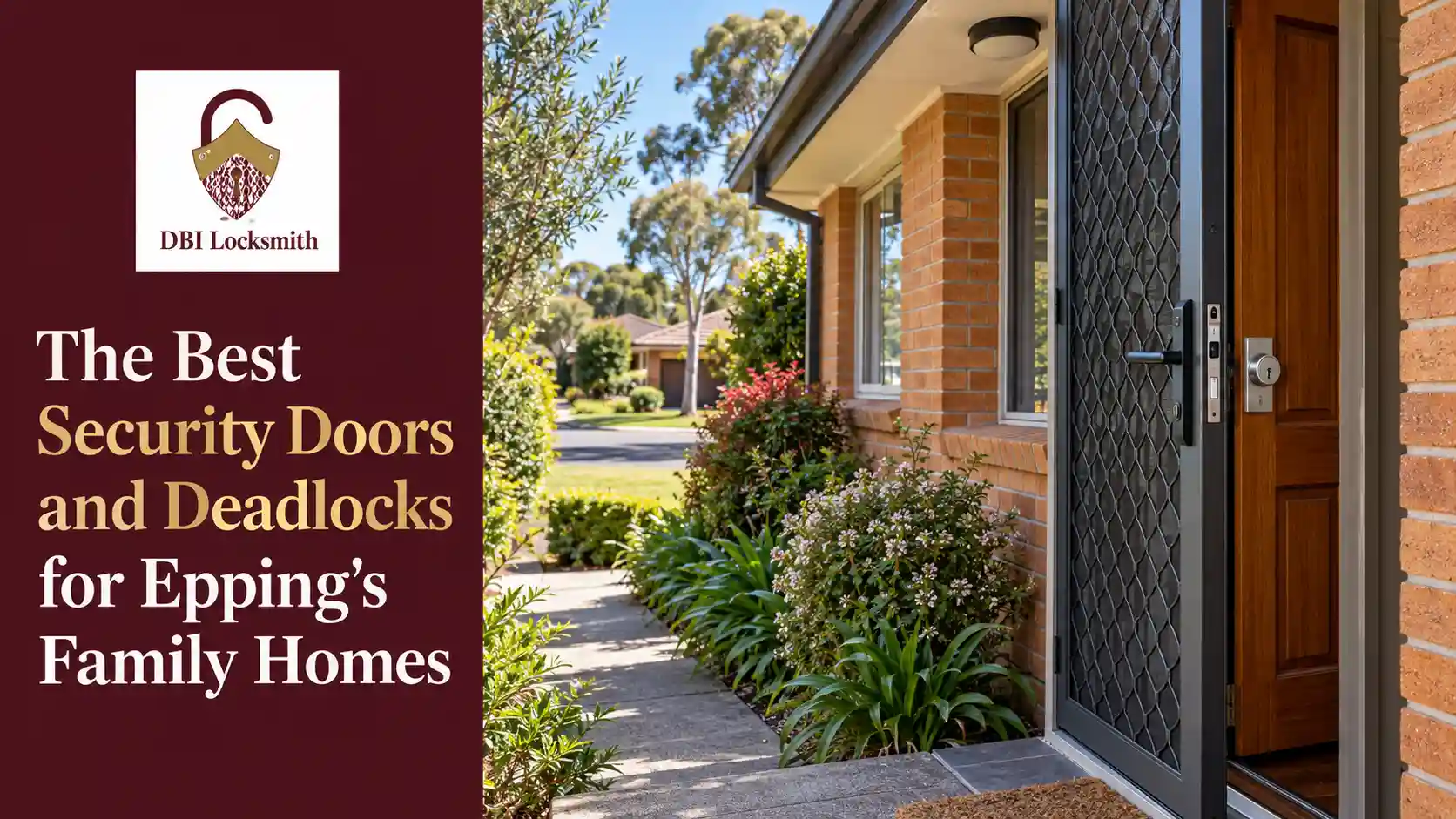
Epping is a suburb of families. With 78.8% family households, an average of 2.9 people per dwelling, and a population projected to exceed 50,000 by 2030, it is one of Melbourne’s most family-dense outer-suburban growth corridors. The housing that families are buying into — house-and-land packages in Aurora and Hargrove, established brick homes on the established High Street grid, townhouses in the new releases off Edgars Road and Epping Road — all have security hardware that ranges from adequate to genuinely inadequate.
Meanwhile, Epping’s crime profile is real: 205 residential burglaries annually, property and deception offences topping 4,200 incidents per year, theft increasing 6.95% year-on-year, and a total crime rate 22% higher than five years ago. For a family that’s committed significant financial and emotional resources to a home in this suburb, security hardware that reflects the value of what’s been committed is a practical priority.
This is a guide to the security door and deadlock decisions that Epping families are making, what the options actually are, and what the differences between them mean for real-world security.
Deadlock Grades: What Your Epping Home Probably Has vs. What It Should Have
Australian residential deadlocks are graded under the AS 4145 standard, with Grade 1 being the lowest (minimal security function) and Grade 6 the highest (tested to withstand determined, sustained forced entry attempts). For an external residential door, Grade 5 or Grade 6 is the appropriate specification.
New estate homes in Epping — the Aurora Estate builds, the Hargrove releases, the current new-build offerings — are typically delivered with builder-standard Grade 3 or Grade 4 deadlocks. These locks function: they engage, they hold the door, they provide some resistance to casual pushing. What they’re not rated for is the systematic forced entry resistance of Grade 5 or 6 hardware — resistance to picking, drilling, and physical forcing that independently tested grade ratings require.
Established brick homes in central Epping’s original village grid have typically gone through one or more rounds of lock replacement since they were built in the 1970s. The replacement hardware may be Grade 5 or 6 from a recent update, or it may be a direct hardware store equivalent from fifteen years ago with no clear grading. Assessing what’s currently installed — and whether it matches the suburb’s risk profile — is worthwhile.
The deadlock cylinder is separately specified from the lock body. A Grade 5 lock body with a standard non-restricted cylinder is still a Grade 5 lock, but its key control is weak — copies can be made freely. A Grade 5 lock with a restricted-keyway cylinder provides both the physical security of the graded hardware and controlled key duplication: copies only through the authorised locksmith, with written authorisation from the registered owner.
Pro Tip: When upgrading deadlocks on an Epping family home, key all external entries alike — one key for front door, rear door, any side entry, and padlocks — and fit a restricted-keyway cylinder across all of them. Simplifying to one key increases the likelihood it’s used correctly every time, and restricted keyways prevent casual duplication.
Security Doors: What the AS 5039 Standard Means in Practice
Security doors and screens are assessed under AS 5039-2008, which subjects them to knife-shear, impact, jemmy, and pull tests simulating realistic forced entry attempts. Products compliant to this standard carry a rating of P1 (standard) or P2 (enhanced — tested to higher resistance levels). P2-rated products are the appropriate specification for the external entries of an Epping family home.
The AS 5039 grading is the only independent verification that a security door performs as claimed. A product described as a “security door” or a “heavy-duty security screen” without AS 5039 grading has not been independently tested. The difference in real-world performance between a graded P2 product and an ungraded “security-style” door can be substantial — but it’s invisible from appearance alone.
The two main categories of AS 5039-rated security doors:
Steel bar grille doors: the traditional heavy steel or aluminium bar grille in a solid frame, with a deadlock. Structurally robust, visually substantial, provides clear security signal. Trade-off: limited outward visibility through the grille, reduced natural light, limited ventilation. On Epping’s established brick homes — particularly the 1970s construction around High Street — a well-fitted steel grille door can complement the heritage character of the streetscape. It also provides a clear visual deterrent that the suburb’s crime profile makes relevant.
Security mesh screen doors: fine welded steel or stainless steel mesh in a powder-coated aluminium frame, with a locking mechanism. When manufactured to AS 5039 P2 specification, the mesh is extremely difficult to cut, punch or peel — the interlocking weld structure resists the knife-shear test specifically. Security mesh doors allow full outward visibility, natural light, and ventilation — a meaningful quality-of-life factor in Epping’s warm summer months. For new estate homes where the facade aesthetic matters and a steel grille would look incongruous on a contemporary double-storey build, a P2-rated security mesh door in a powder-coat colour matched to the door palette is the natural choice.
The Strike Plate: The Most Overlooked Security Element
The strike plate — the metal plate morticed into the door frame that the deadbolt extends into when the door is locked — is the element that most determines a door’s resistance to being kicked in, and it receives almost no attention in most security conversations.
On Epping’s established brick homes, original strike plates are typically face-mounted: a flat plate with a hole, attached to the door lining timber with 25-30mm screws. When a door fitted with a Grade 5 deadlock and a quality security screen is kicked, the force goes through the bolt into the strike plate, through the short screws, and into the door lining timber — which is soft compared to the structural jamb behind it. A determined kick can pull those screws through the lining timber regardless of the grade of the deadlock.
Upgrading to a full-box strike — a deeper plate with a pocket that supports the bolt on three sides — fitted with 75-100mm screws that reach the structural timber behind the lining is the most significant single forced-entry resistance improvement available on most Epping properties. It’s a fifteen-minute job that costs very little and substantially changes the door’s kick resistance.
On new estate homes in Epping, the original strike plate is the builder’s standard fitting — face-mounted, short screws, into whatever the door lining construction allows. This is one of the first things I check on a new estate home security assessment.
Pro Tip: On an Epping estate home, check the strike plate on the front entry by looking at the screw heads: if they’re visible flat screws on a plate less than 25mm deep, it’s a face-mounted strike. A box strike replacement takes fifteen minutes and changes the kick resistance of the door significantly.
Window Security on Epping Family Homes
Ground-floor windows on Epping family homes — particularly on the established brick homes around High Street and the original village streets — are often fitted with aluminium friction latches or standard factory latches. These keep the window closed but do not lock.
Ground-floor windows on the sides and rear of a property, facing areas not clearly visible from the street, are an access point that receives less security attention than doors but presents similar vulnerability. Key-operated window locks fit to the existing frame or sash without modifying the glass or frame, and convert a latched window into a locked one.
On Epping’s newer estate homes, ground-floor windows in the living and kitchen areas that face the alfresco or rear garden are typically aluminium sliding windows with factory friction latches. These windows are often left on latch (not properly locked) during warm weather — a ventilation habit that’s understandable but creates an access opportunity.
A Northern Hospital Corridor Assessment: What We Found
I was called to an established brick home on a side street off Cooper Street — a family home, parents both working shifts in healthcare, school-age children, the property purchased about four years ago when they moved to Epping for proximity to The Northern Hospital. A neighbouring property had been broken into through the rear, and they wanted a straight assessment of where they stood.
Front entry: an older Grade 4 deadlock, non-restricted keyway, face-mounted strike plate with 30mm screws. No security screen. Rear door off the kitchen: a passage set with a privacy lock — no deadlock at all. Two ground-floor windows on the rear: aluminium sliders with friction latches only. Side passage gate: a basic latch reachable from above.
We fitted a P2-rated steel grille security screen on the front entry, upgraded the front deadlock to Grade 5 with a restricted-keyway cylinder, fitted a Grade 5 deadlock on the rear kitchen door, replaced the front strike plate with a full-box strike on 90mm screws, fitted key-operated locks on the two rear windows, and fitted a key-operated gate bolt on the side passage. Two visits, four hours total.
The family now has a clear picture of their security: graded hardware on every external entry, a restricted keyway so key duplication is controlled, and no weak points on the perimeter that were visible from the rear approach.