
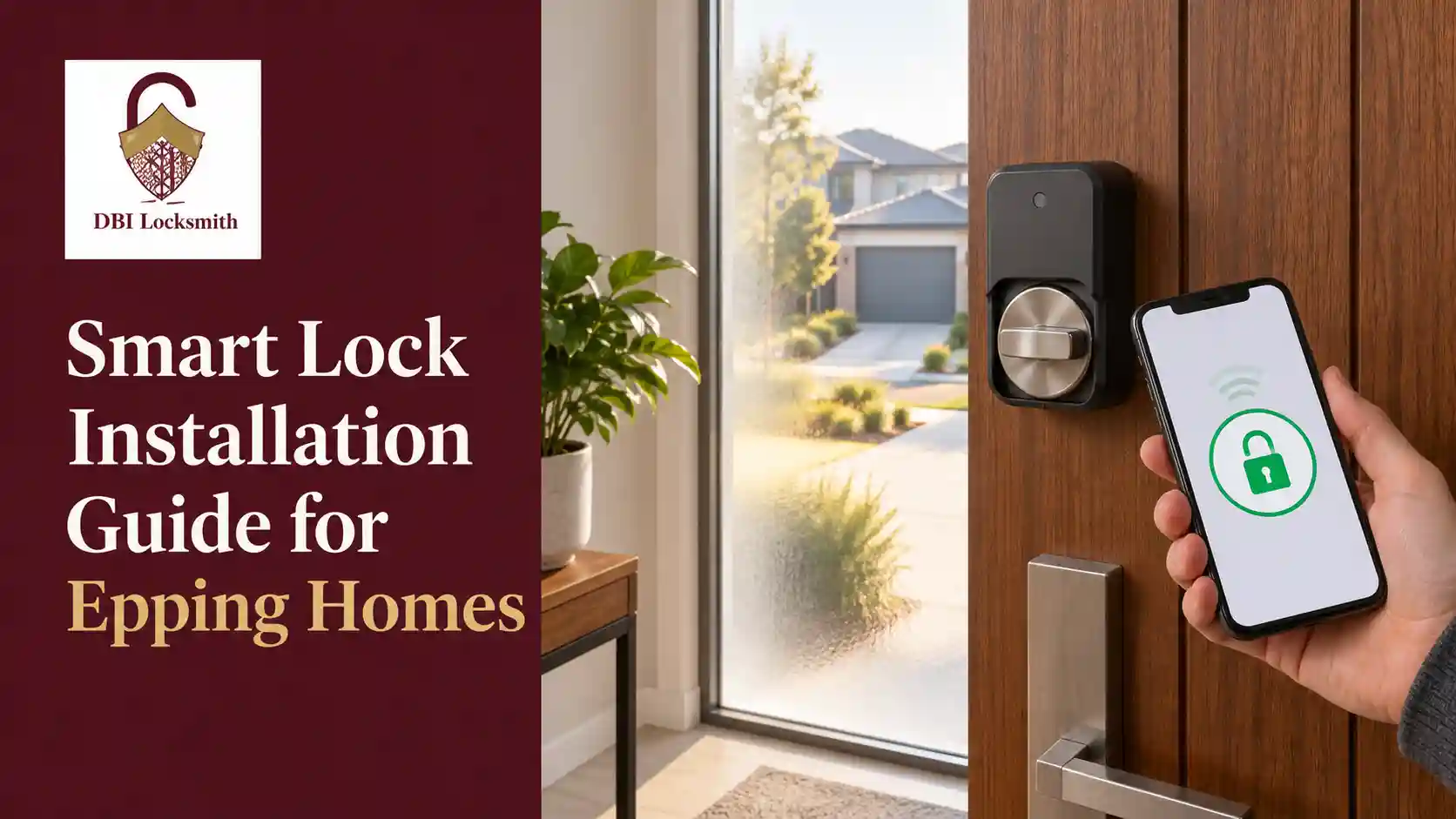
Epping’s housing profile makes it one of the most naturally suited suburbs in Melbourne’s north for smart lock adoption. The suburb’s demographics — dual-income families, shift workers at The Northern Hospital, young professionals commuting on the Mernda line to the CBD, renters cycling through on short tenancies — are all household types where physical key management creates real friction.
Think about the everyday scenarios. A parent returning from a late hospital shift to a locked house when their partner’s already asleep. A teenager coming home from school two hours before anyone else. A tradesperson needing access during a bathroom renovation while the owners are at work at the Somerton industrial park. A landlord wanting to manage access across multiple Epping rental properties without being the person who drives out with a key every time. Smart locks are not a luxury product in this context — they’re a practical tool for households that juggle access across multiple schedules and users.
Here’s a honest, suburb-specific guide to what smart lock installation looks like for Epping properties.
Epping’s Two Housing Types and What They Mean for Compatibility
Epping’s housing divides clearly into two categories, and they have different smart lock compatibility situations.
New estate homes (Aurora, Hargrove, Harvest Home Road corridor, and any of the current or recent releases): These properties have been built within the last fifteen to twenty years, typically with contemporary 60mm backset deadlocks on solid-core doors. Backset standardisation in this era is good — the 60mm backset that retrofit smart lock adaptors are designed around is what these doors usually have. Door weight and construction are appropriate for smart lock mounting. Compatibility with retrofit adaptors is generally high; a quick check of the cylinder brand and existing hardware configuration before purchasing confirms it.
Older Epping properties (the established streets in central Epping around High Street and the original village core): These homes are typically 1970s-era brick veneer with replacement lock hardware of varying ages and specifications. Backset may not be standard — 60mm, 70mm, and even imperial measurements appear on older Australian residential hardware. These properties need a compatibility assessment before any hardware purchase. The payoff is that older Epping homes often have lower-grade original hardware that warrants replacement at the same time as the smart lock upgrade — the two projects can be combined efficiently.
Pro Tip: Measure the backset (edge of door to cylinder centre) before buying any smart lock hardware — not all products fit all backsets, and a 60mm-rated product on a 70mm backset door will not seat correctly. A five-minute measurement avoids an expensive return.
The Retrofit Adaptor vs Full Replacement: Which Suits Epping Properties?
Retrofit smart lock adaptors fit to the inside face of an existing deadlock cylinder. The motor engages the turn button on the inside of the lock; the external hardware — keyhole, handle, deadlock face — is completely unchanged. Smart credentials (PIN, phone app, NFC fob) are added without any modification visible from outside the door.
This is the right choice for:
- Epping renters with landlord permission — Nothing changes externally, making the landlord conversation easier.
- New estate homes where the existing deadlock cylinder is in good condition and the owner wants to preserve the builder’s external hardware aesthetic.
- Homeowners in established Epping properties who want smart access without replacing functioning hardware.
- Full replacement smart deadlocks replace the existing lock cylinder and external hardware entirely with a new combined unit. The external face may include a keypad, fingerprint reader, or digital display. Best choice for:
- Owner-occupied Epping homes where the existing hardware is builder-grade or worn and warrants replacement regardless.
- Homeowners who specifically want external keypad or fingerprint access — convenient for school-age children coming home, for households where PIN entry is preferred over phone app.
- Properties where the external hardware is being refreshed as part of a broader renovation.
For most new Epping estate homeowners, the full replacement option makes sense: the builder-standard cylinder warrants upgrading anyway (to Grade 5 hardware with a restricted keyway), and combining the hardware upgrade with smart lock integration does both jobs in one visit.
Remote Access: The Feature Epping’s Commuter Households Use Most
The Mernda line connects Epping Station to the CBD in approximately 50 minutes. The SmartBus 901 crosses the suburb on a cross-suburban corridor. Cooper Street and Epping Road carry the M80 commuter traffic. Epping is a suburb of commuters — people who leave early, return at variable times, and need the household to function independently between departure and return.
Remote access — the ability to lock or unlock the front door from anywhere via a phone app — is the smart lock feature that fits this context most directly. Sitting at the desk in a city office, unable to remember whether the front door was locked in the rush of the school run, a remote check takes five seconds and costs nothing. A child who forgot their key doesn’t mean a two-hour wait on the front step — it means a remote unlock from a parent’s phone.
For Epping’s rental properties — 29% of the suburb’s dwellings — the access management benefit extends to tenancy management. A landlord managing Epping rentals can issue individual PIN codes to each tenant, set time-limited codes for maintenance contractors, and revoke access when a tenancy ends, all from a phone app, without physically attending the property.
Remote access requires either Wi-Fi connectivity built into the smart lock, or a separate bridge device that connects the lock to the home network. Bluetooth-only smart locks require the managing phone to be within Bluetooth range of the lock — approximately 10 metres — which means no remote management from the office or the train. For Epping commuter households, Wi-Fi or bridge connectivity is the appropriate specification.
Pro Tip: For an Epping rental property, choose a smart lock that supports at least 8 individual PIN codes and a time-limited or single-use code function — this gives enough codes for current tenants plus a property manager access code, and lets you issue time-limited contractor codes without giving permanent access.
The Battery and Backup Situation
Smart locks in residential applications are battery powered — typically four AA batteries. Battery life ranges from 6 to 18 months depending on use frequency and the model. Quality products push low-battery notifications to the app weeks before the battery is depleted.
The physical backup key — a conventional cylinder override that accepts a mechanical key — is present on every reputable smart lock. This key is the failsafe for complete battery failure. It needs to be accessible outside the locked property — a trusted neighbour, a family member nearby, or a key lockbox mounted in a secure location.
For Epping’s two-car households, “accessible outside the property” is usually easy to arrange: one partner keeps the physical backup key on their car keyring, or it stays with a neighbour two doors down. The key lockbox option also works well for households who want a completely keyless daily experience — the lockbox provides physical key access for the rare situations where the app and battery have both failed, without the lockbox being the primary entry method.
Cloud platform reliability: this is an underappreciated consideration in smart lock purchasing. A smart lock that requires a cloud platform to operate its remote features is vulnerable to that platform being discontinued — several smart lock manufacturers have shut down their cloud services in the past five years, leaving customers with locks that could no longer be remotely managed. Choosing a brand with an established Australian market presence and confirming the lock can operate locally (PIN, physical key, NFC fob) without the cloud connection provides protection against this scenario.
A Cooper Street-Adjacent New Estate Installation: How It Went
I was called to a new estate home in the O’Herns Road area of north Epping — a dual-income family, one partner working shifts at The Northern Hospital, the other managing a small business from home. They’d bought off the plan eighteen months earlier and had been using the builder’s standard key since handover. The main frustration: the hospital shift worker was arriving home at 6am or 11pm with sleeping family inside and wanting to enter quietly without fumbling for a key or waking anyone.
The front door had a builder-standard Grade 3 deadlock on a solid-core door, 60mm backset — ideal for a retrofit adaptor. The rear sliding door had the builder’s face latch and no secondary lock; we addressed that separately as part of a broader security visit.
We fitted a retrofit smart lock adaptor to the front entry, connected it to the home’s Wi-Fi, configured two app accounts (one per adult household member), set a PIN code for the school-age children, and issued a property manager-style code for the grandparents who helped with pickups three days a week. Physical backup key: on the shift worker’s hospital lanyard.
The shift worker has since told me that arriving at 6am and slipping a phone near the door — no key required, no fumbling, no light needed — has been the most appreciated home improvement of the year.